
WHO IS FOOLING WHOM? KENYA’S KSH 13.5 TRILLION DEBT AND THE BLAME GAME
Kenya’s debt has passed KSh 13.5 trillion and is eating most tax revenue. Analysis argues the problem is a system that rewards borrowing over results, not China alone.
Watch Getembe TV Live
Broadcast Getembe TV Live Stream
Listen Getembe FM Live
Tune in to Getembe FM Live Broadcast
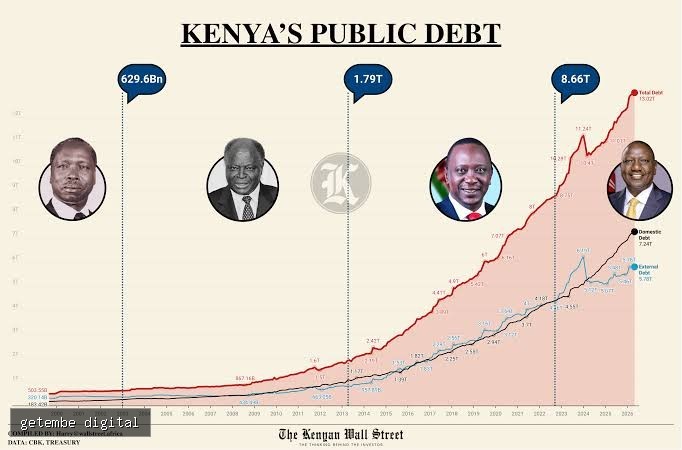
Kenya’s public debt has crossed KSh 13.5 trillion. In mid-October 2026, the Institute of Economic Affairs put the figure at about KSh 13.5 trillion. That means every Kenyan owes roughly KSh 248,000. In June 2026 the National Treasury said the debt was KSh 13.12 trillion about 68 to 70 percent of the size of the whole economy. That is much higher than the 55 percent limit Parliament once set.
Look at where the money is owed. More than half of the debt about 55 to 56 percent, or KSh 7.6 to 7.8 trillion is money the government borrowed domestically. The rest, about KSh 5.7 to 5.8 trillion, is money owed to foreign lenders.

Among the foreign debt, the biggest lenders are international organisations such as the World Bank. Commercial lenders, including people who bought Kenya’s international bonds, come next. China is still the largest single country Kenya owes money to, but it is only about KSh 620 billion roughly 11 percent of the foreign debt. China’s share has actually gone down by almost one-fifth since 2021.
Yet the public talk stays the same. The government talks about cutting the budget deficit and collecting more taxes. Officials say the borrowed money built roads, railways and power plants. But the numbers show something different. In the first three months of the 2026/27 budget year, the government spent KSh 490.5 billion on debt payments. In the same period it collected only KSh 631.8 billion in taxes. That means debt took 77.6 percent of all tax money. For the full year, the budget plans to use more than 80 percent of tax money just to pay debts. Money for new projects and for counties is left with very little.
So who is fooling whom?
Politicians have become good at remembering only what helps them. One government after another borrowed heavily for big projects. Many of those projects looked good for politics more than for making money. The Standard Gauge Railway is the best-known example expensive, built with Chinese money, and still struggling to pay for itself. But the big borrowing was never only about China. Kenya also borrowed a lot through international bonds and from local banks and pension funds. When the bills become hard to pay, the same leaders talk about “debt we inherited” or “problems from the rest of the world.”
China is an easy target. The idea that China is trapping African countries in debt spreads quickly. But the figures show China is not the biggest lender and its share is shrinking. International organisations and commercial bond holders own a much larger part of the debt. Blaming only China lets everyone else off the hook the local leaders who mismanaged projects, the commercial lenders who charged high interest, and the big international lenders who kept approving new loans even when the warning signs were clear.
The lenders are not blameless either. They gave money knowing Kenya had weak controls, projects often cost more than planned, and the country might struggle to repay. Political friendships and soft conditions often mattered more than careful checks. When problems appear, these same lenders tell Kenya to cut spending. The cuts hit ordinary people hardest the people who never sat in the meetings where the loans were signed.
And ordinary Kenyans? Many are rightly angry. Protests over higher taxes and the high cost of living have shown how deep the frustration runs. But public talk sometimes settles for the simplest story “China is trapping us” instead of demanding clear answers about every loan, every project, and every unexplained extra cost. The Auditor-General has pointed out problems. Parliament has the power to check borrowing more carefully. Too often both are treated as less important.
The real fooling is shared. Governments present debt as investment while debt payments take money away from health, education and jobs. Lenders present themselves as partners who help development while taking returns that leave the country under constant pressure. Opposition leaders and activists correctly point out the heavy burden, but sometimes simplify the reasons for political gain. Ordinary people are told the pain is temporary and necessary, even as the total debt keeps rising and interest payments take a bigger and bigger share of the budget.
This does not mean Kenya is finished. Debt can be useful when it pays for things that help the economy grow and bring in more money later. The problem is the big gap between the talk of progress and the reality of unclear contracts, weak project choices, and political incentives that favour quick visible projects over long-term results. Until that gap is closed with open loan agreements, serious checks on value for money, stronger oversight by Parliament, and real control of spending the debt numbers will keep rising and the stories will keep changing.
Kenya is not being trapped by any one foreign power. It is being trapped by a system that rewards borrowing more than results, and by a public conversation that prefers easy villains to hard numbers. The debt is real. The interest is real. The citizens paying for it are real. Everything else is just negotiation.
ADVERTISEMENT
Watch Getembe TV Live
Broadcast Getembe TV Live Stream
Listen Getembe FM Live
Tune in to Getembe FM Live Broadcast
How do you feel about this article?
Let us know by choosing a reaction below.

Written by FRANKLINE NYANDORO
Reporter and staff writer at Getembe News.
Comments 0
Please log in to participate in the comments section.
No comments yet. Be the first to share your thoughts!
ADVERTISEMENT
Related Stories

Have a news tip?
Do you have an investigation, local story or news event you think we should cover? Contact our newsroom directly.
Submit Tip
Mobile App
Download Getembe Digital App Today
Download Getembe Digital App today for live news updates, breaking notifications, and seamless live streaming.