
BEYOND THE POLITICAL BATTLES: WHOSE INTERESTS IS KENYA’S PARLIAMENT REALLY REPRESENTING?
MPs are asking tough questions on the KSh154.2 billion JKIA project. But will Parliament follow through, or is politics overshadowing oversight?
Watch Getembe TV Live
Broadcast Getembe TV Live Stream
Listen Getembe FM Live
Tune in to Getembe FM Live Broadcast
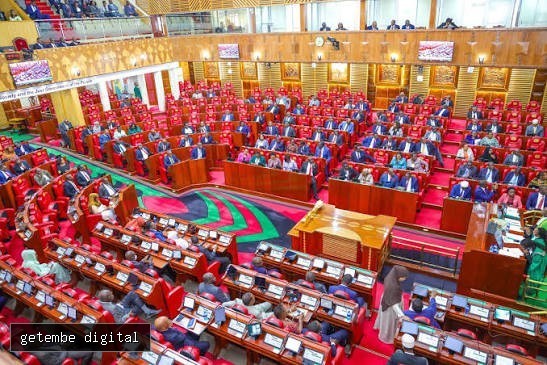
Kenya's Parliament was never meant to be a meeting place where political heavyweights settle scores, negotiate their survival, protect powerful interests or compete for proximity to State power. It was established as an institution through which citizens exercise their sovereignty, hold the government accountable and demand answers from those entrusted with public resources.
Yet, increasingly, the question confronting Kenyans is whether Parliament is giving sufficient attention to this constitutional responsibility or whether the institution is becoming increasingly consumed by the political interests of the country's powerful elite.
The latest debate surrounding the KSh154.2 billion modernisation of Jomo Kenyatta International Airport (JKIA) offers an interesting illustration of this dilemma.
On Tuesday, November 10, 2026, members of the National Assembly's Departmental Committee on Transport and Infrastructure visited JKIA, where they questioned the involvement of Kenyan companies in the multibillion-shilling project being undertaken by China Road and Bridge Corporation (CRBC).
The legislators demanded evidence that local firms, engineers, professionals and suppliers were benefiting from the construction works. They also questioned why procurement responsibilities had shifted from the Kenya Airports Authority (KAA) to the Ministry of Roads and Transport.

These are important questions. A project worth more than KSh154 billion cannot be discussed merely in terms of the buildings it will deliver, the machines deployed or the foreign contractor awarded the tender. Kenyans deserve to know how much of that investment will circulate within the domestic economy, create employment, develop local expertise and strengthen local businesses.
But the bigger question is what happens after Parliament raises these concerns.
Will the committee demand documentary evidence, examine procurement records, establish the actual proportion of contracts awarded to Kenyan companies and publish its findings? Will the House follow through on the questions it has raised, or will the visit become another parliamentary engagement that generates headlines without producing meaningful accountability?
This is where the conversation about the state of Parliament becomes unavoidable.
Article 95 of the Constitution gives the National Assembly an unmistakable responsibility: representing citizens, deliberating on matters affecting them, passing legislation, appropriating public funds and exercising oversight over national revenue and expenditure.
These are not ceremonial responsibilities. They are the very reasons taxpayers finance the institution and elect representatives to occupy its seats.
However, the public's experience of parliamentary politics increasingly raises questions about the balance between these responsibilities and the political calculations that shape the country's leadership.
Political alignments, defections, succession debates, competing power centres, parliamentary confrontations and the struggle for influence frequently dominate the national political conversation. The approach of the 2027 General Election is also likely to intensify these competing interests.
None of these activities is inherently unconstitutional. MPs have political rights, parties have interests to defend, and parliamentary democracy naturally involves disagreement.
The problem emerges when the pursuit of political relevance begins to overshadow the responsibility of public representation.
A Parliament that spends considerable political energy negotiating positions within the country's power structures must also demonstrate that it is giving comparable attention to the cost of living, public debt, unemployment, the quality of education, healthcare financing, corruption and the management of public projects.
The question is not whether politicians should engage in politics. Parliament is a political institution. The question is whether politics has become more important than the public interest it is supposed to serve.
The JKIA project presents Parliament with an opportunity to demonstrate what meaningful oversight should look like.
The Ministry of Roads and Transport says the procurement process began on March 3, 2026, and closed in May, with two bidders participating before CRBC emerged as the preferred contractor. The government subsequently signed the KSh154.2 billion contract in June 2026.
The Ministry has defended the project as necessary, arguing that JKIA handles more than 10 million passengers annually against an existing capacity of approximately 7.5 million.
The cancellation of the earlier Adani proposal following widespread public opposition also makes the new arrangement particularly important to scrutinise. The public should not have to wait for controversy to emerge before learning how major infrastructure decisions are made.
MPs are therefore right to question the transfer of procurement responsibilities from KAA to the ministry. They are equally right to demand evidence of local participation.
But asking questions during an inspection is only the beginning of oversight, not its conclusion.
The committee should establish the contractual obligations surrounding local content, the number of Kenyan professionals employed, the value of subcontracts awarded to domestic firms and the proportion of locally manufactured materials being used.
It should also examine whether the procurement process complied with applicable laws and whether the reasons for transferring the process from KAA to the ministry were adequately documented.
Without such follow-through, parliamentary oversight risks becoming an exercise in public performance rather than an effective mechanism for protecting public resources.
There is another uncomfortable dimension to Kenya's parliamentary politics.
The country's political establishment often operates through powerful personalities whose influence extends beyond the formal responsibilities of their offices. National conversations can become dominated by who is aligned with whom, who is gaining influence, who is losing political ground and who is positioning themselves for the next contest.
Meanwhile, the ordinary Kenyan encounters a different set of concerns.
A parent wants to know whether their child will receive quality education without being subjected to endless financial demands. A young graduate wants employment. A small business owner wants an economic environment that allows their enterprise to survive. A patient wants an adequately funded hospital.
These concerns require more than political declarations and occasional parliamentary visits.
They require legislation, rigorous budget scrutiny, sustained investigations and measurable accountability.
The danger is that when Parliament becomes overly absorbed in the interests of powerful political actors, citizens can gradually lose sight of what their representatives are actually doing on their behalf.
The institution then risks becoming more visible during political confrontations than during the painstaking work of protecting public resources.
That is a serious question for a country whose Constitution places sovereign power in the hands of the people.
Kenya does not need a Parliament that merely generates political headlines. It needs one that can interrogate the government without fear, scrutinise public expenditure without favour and demand answers regardless of the political connections of those involved.
The JKIA expansion is one of many opportunities to demonstrate that responsibility.
The KSh154.2 billion investment deserves sustained scrutiny, not simply because a Chinese company is undertaking the works, but because the money involved, the procurement arrangements and the economic opportunities created have direct consequences for Kenyans.
The same determination demonstrated when questioning CRBC should extend to government ministries, State corporations, public procurement decisions and every institution managing taxpayers' money.
Ultimately, Parliament's credibility will not be measured by the number of press conferences its members hold, the number of government officials they summon or the political battles they win.
It will be measured by the questions they ask, the answers they secure, the public resources they protect and the tangible improvements citizens experience.
The Constitution did not establish Parliament to serve as a political playground for the country's powerful personalities. It established it as an institution of public representation and accountability.
And perhaps the most important question Kenyans should continue asking their representatives is simple: beyond the political battles, whose interests are you actually representing?
ADVERTISEMENT
Watch Getembe TV Live
Broadcast Getembe TV Live Stream
Listen Getembe FM Live
Tune in to Getembe FM Live Broadcast
How do you feel about this article?
Let us know by choosing a reaction below.

Written by FRANKLINE NYANDORO
Reporter and staff writer at Getembe News.
Comments 0
Please log in to participate in the comments section.
No comments yet. Be the first to share your thoughts!
ADVERTISEMENT
Related Stories

Have a news tip?
Do you have an investigation, local story or news event you think we should cover? Contact our newsroom directly.
Submit Tip
Mobile App
Download Getembe Digital App Today
Download Getembe Digital App today for live news updates, breaking notifications, and seamless live streaming.