
RUTO RETURNS TO WESTERN KENYA AS SIFUNA’S RISE REDRAWS THE POLITICAL MAP
Ruto heads back to Western Kenya as a TIFA poll puts Sifuna ahead. Can Mudavadi and Wetang’ula hold the region for 2027?
Watch Getembe TV Live
Broadcast Getembe TV Live Stream
Listen Getembe FM Live
Tune in to Getembe FM Live Broadcast
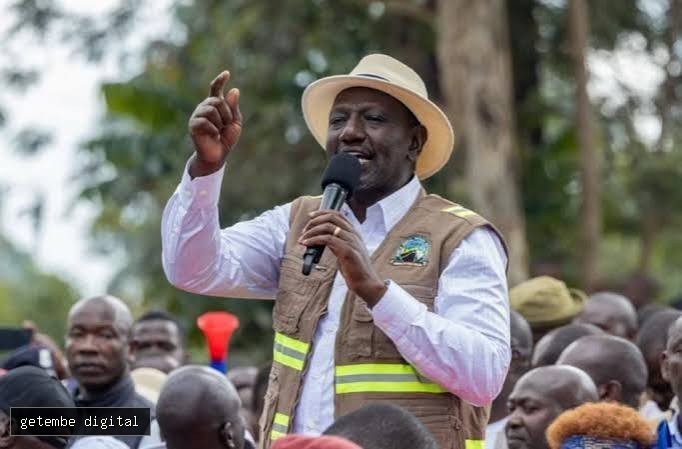
President William Ruto is preparing to return to Western Kenya in a fresh political mobilisation drive as his allies face growing competition from opposition leaders seeking to challenge his influence in the region ahead of the 2027 General Election.
According to an itinerary circulated by local United Democratic Alliance (UDA) officials, Ruto is expected to begin his tour on November 19, traversing parts of the region until November 24 before resuming his engagements between November 28 and November 30.
The planned visit comes amid growing political activity in Kakamega, Bungoma, Busia, Vihiga and Trans Nzoia, where competing political formations are seeking to consolidate grassroots support.
The President's mobilisation efforts are being spearheaded by senior government figures, including Prime Cabinet Secretary Musalia Mudavadi and National Assembly Speaker Moses Wetang'ula, who have repeatedly urged residents to support his second-term ambitions.
However, the political environment in the region presents a complicated picture for the ruling coalition.
A TIFA Research opinion poll placed Nairobi Senator Edwin Sifuna ahead of Ruto in Western Kenya, with 55 per cent of respondents expressing preference for Sifuna compared to 25 per cent for the President.
The survey, conducted between October 26 and November 5 among 2,036 respondents nationally, had a margin of error of plus or minus 2.16 percentage points.
The findings point to an increasingly competitive political environment in a region that has traditionally played an important role in opposition politics.
Ruto's political strategy in Western Kenya largely depends on the influence of Mudavadi and Wetang'ula, both of whom have positioned themselves as key intermediaries between the region and the national government.
Mudavadi has been particularly vocal in defending the administration's political arrangement, recently expressing frustration with residents who continue demanding the fulfilment of development promises made during the 2022 election campaigns.
During a UDA delegates' meeting in Mumias East, Kakamega County, Mudavadi questioned why residents were blaming him for the unfulfilled 30 per cent development commitment he had previously championed.
He argued that residents who had declined to support Ruto in 2022 should not hold him personally responsible for their development expectations.
His remarks, however, highlighted the challenge facing the ruling coalition as it attempts to translate government representation into electoral support.
Wetang'ula has also intensified his mobilisation efforts, arguing that backing Ruto would strengthen Western Kenya's bargaining position in government and potentially advance the region's long-term political ambitions.
The two leaders have maintained that supporting Ruto in 2027 could position Western Kenya for greater influence in the country's political succession discussions.
Meanwhile, Sifuna's growing political profile has introduced a new dimension to the contest.
Through the Linda Mwananchi movement, the Nairobi Senator has attracted political support from leaders opposed to the broad-based government arrangement, with the movement holding political engagements across several Western Kenya counties.
His growing influence has also complicated the traditional political calculations of Mudavadi and Wetang'ula, who have historically played prominent roles in determining the region's political direction.
The contest is increasingly becoming about more than presidential endorsements, with questions of regional representation, development commitments and political leadership emerging as central campaign issues.
Western Kenya remains an important electoral region, with approximately 2.89 million registered voters across its five counties.
The figure is expected to rise to approximately 3.4 million ahead of the 2027 General Election, according to voter registration projections .
This makes the region an important constituency for political formations seeking to build a nationwide electoral coalition.
Ruto's allies are therefore pushing voter registration alongside their political mobilisation efforts, hoping to expand the number of eligible voters and strengthen their grassroots structures.
The President's return will also come against the backdrop of opposition efforts to counter his recent political engagements in different parts of the country.
Former Deputy President Rigathi Gachagua has previously described a strategy in which opposition leaders follow Ruto's campaign tours to challenge his messaging and reconnect with local voters.
As the 2027 election approaches, Western Kenya is emerging as an increasingly contested political arena, with established political brokers facing competition from newer movements and leaders seeking a greater say in the region's political future.
Ruto's forthcoming tour will provide another opportunity for him and his allies to present their development record and make their case for continued political support.
ADVERTISEMENT
Watch Getembe TV Live
Broadcast Getembe TV Live Stream
Listen Getembe FM Live
Tune in to Getembe FM Live Broadcast
How do you feel about this article?
Let us know by choosing a reaction below.

Written by FRANKLINE NYANDORO
Reporter and staff writer at Getembe News.
Comments 0
Please log in to participate in the comments section.
No comments yet. Be the first to share your thoughts!
ADVERTISEMENT
Related Stories

Have a news tip?
Do you have an investigation, local story or news event you think we should cover? Contact our newsroom directly.
Submit Tip
Mobile App
Download Getembe Digital App Today
Download Getembe Digital App today for live news updates, breaking notifications, and seamless live streaming.