
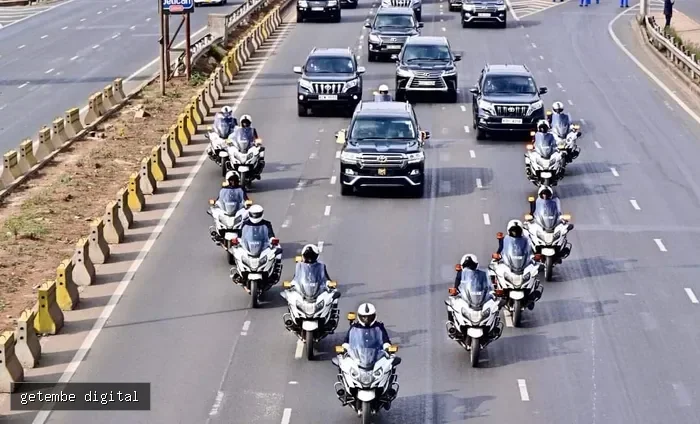
WHY DOES THE PRESIDENT’S CAR DRIVE IN THE MIDDLE OF THE ROAD? WHAT WE KNOW AND DON’T
Is the President’s car in the middle of the road to avoid ambushes? A look at how motorcades work, and what can and can’t be confirmed.
Watch Getembe TV Live
Broadcast Getembe TV Live Stream
Listen Getembe FM Live
Tune in to Getembe FM Live Broadcast
While many assume the vehicle is positioned there to keep potential threats at a distance, the actual reasons can depend on the road, traffic conditions and the security arrangements in place. Understanding the strategy requires looking beyond the armoured car to the wider operation surrounding it.
To an ordinary motorist, the manoeuvre may look like a way of demanding priority on the road. But presidential transport involves more than simply moving a vehicle from one destination to another. It is part of a carefully coordinated security operation in which route planning, traffic control, trained drivers and escort vehicles all play a role.
To an ordinary motorist, the manoeuvre may look like a way of demanding priority on the road. But presidential transport involves more than simply moving a vehicle from one destination to another. It is part of a carefully coordinated security operation in which route planning, traffic control, trained drivers and escort vehicles all play a role.
Presidential motorcades are designed to reduce the risks associated with transporting a head of state through public spaces. The Presidential Escort Unit is involved in close protection, armoured motorcades and advance security arrangements before presidential movements.
These preparations help security teams assess routes, coordinate escorts and identify potential challenges along the way.
The positioning of the presidential vehicle may therefore be influenced by the road layout, traffic conditions, the movement of escort vehicles and the requirements of a particular security operation.
Why the centre of the road matters
One possible explanation is the need to maintain adequate space around the vehicle. Depending on the road and the formation being used, positioning the vehicle away from the immediate roadside may provide additional room to manoeuvre and help the driver respond to unexpected obstacles.
Roadside threats, including explosive devices and ambushes, are among the risks considered in protective motorcade planning. US government security guidance identifies vehicle-borne explosives and roadside improvised explosive devices as threats that must be considered when planning motorcade movements.
However, this does not mean that every presidential vehicle driving along the centre line is specifically avoiding an explosive device. Without an official explanation, it would be inaccurate to claim that this is the confirmed reason for the President’s positioning on a particular road.
The role of the escort vehicles
The presidential car does not operate in isolation. Escort vehicles and motorcycle outriders help coordinate movement, manage traffic and maintain the convoy’s formation.
In some motorcade arrangements, security vehicles surround the principal vehicle, while others lead or follow the convoy. The precise formation depends on the circumstances and the security plan.
The aim is to ensure that the convoy can move in a coordinated manner while reducing unnecessary interruptions. Specialist reporting on presidential motorcades also highlights the importance of advance route planning, trained drivers and coordination between escort teams.
Does the positioning allow the car to move faster?
Keeping a motorcade moving smoothly can be an important consideration during protective transport. Sudden stops and unpredictable movements may complicate coordination between vehicles.
But the claim that driving along the centre line automatically allows the presidential car to maintain maximum speed or stability should be treated cautiously. Speed and vehicle stability depend on several factors, including road conditions, vehicle design, driver decisions and the behaviour of surrounding traffic.
There is also no publicly established universal rule requiring every presidential vehicle to drive on the centre line. Different roads and security circumstances may require different approaches.
Security versus public road safety
Although presidential motorcades have specialised security responsibilities, they share public roads with pedestrians, cyclists, motorists and other road users. Their movements can cause temporary traffic disruption and raise questions about road safety.
The challenge is to balance the protection of the Head of State with the safety of the public. A secure journey depends not only on the armoured vehicle but also on planning, trained personnel, traffic coordination and responsible driving.
The challenge is to balance the protection of the Head of State with the safety of the public. A secure journey depends not only on the armoured vehicle but also on planning, trained personnel, traffic coordination and responsible driving.
The next time you see the President’s car occupying the centre of the road, remember that its position may be part of a broader protective arrangement. But the precise reason for that positioning cannot be determined from observation alone and claims about specific anti-ambush tactics should not be presented as confirmed facts without evidence.
ADVERTISEMENT
Watch Getembe TV Live
Broadcast Getembe TV Live Stream
Listen Getembe FM Live
Tune in to Getembe FM Live Broadcast
How do you feel about this article?
Let us know by choosing a reaction below.

Written by FRANKLINE NYANDORO
Reporter and staff writer at Getembe News.
Comments 0
Please log in to participate in the comments section.
No comments yet. Be the first to share your thoughts!
ADVERTISEMENT
Related Stories
Have a news tip?
Do you have an investigation, local story or news event you think we should cover? Contact our newsroom directly.
Submit Tip
Mobile App
Download Getembe Digital App Today
Download Getembe Digital App today for live news updates, breaking notifications, and seamless live streaming.