
KIPCHOGE'S 1:59:40 STILL HAS THE WORLD BREATHLESS, SEVEN YEARS ON
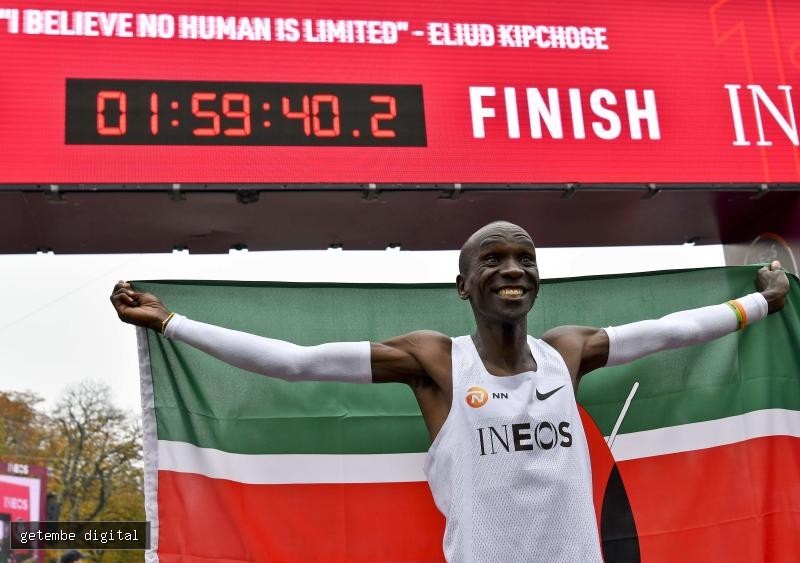
Seven years after Eliud Kipchoge ran 1:59:40 at the INEOS 1:59 Challenge in Vienna on October 12, 2019, the first marathon under two hours still stands as one of sport’s great “what is even possible?” moments.
Watch Getembe TV Live
Broadcast Getembe TV Live Stream
Listen Getembe FM Live
Tune in to Getembe FM Live Broadcast
Seven years ago today, on October 12, 2019, Eliud Kipchoge ran 26.2 miles through a Vienna park and made the stopwatch blink first.
His time at the INEOS 1:59 Challenge was 1:59:40, the first marathon ever run in under two hours. For a man who had spent years making the impossible look routine, it was a fitting encore.
The maths, for those who prefer to suffer from the sofa
To break two hours, a runner must hold roughly 2:50 per kilometre for 42.195 kilometres, which works out to about 4:34 per mile, 26 times in a row. Most of us cannot do that once, on a treadmill, downhill, with a tailwind and a very generous friend holding the stopwatch.
Why it wasn't "official"
Purists were quick to point out that the run doesn't count as a world record. The reasons were practical: it was not an open race, a rotating team of pacemakers shielded Kipchoge from the wind, and a pace car beamed a laser line onto the road to keep him on schedule. Drinks were also handed over by support riders.
The pacemakers were no ordinary jogging buddies. They included elite runners, among them Olympic medallists, taking turns at the front. Few people can say their pacers had better résumés than most people's entire running clubs.
The record that does count
Kipchoge's official marathon world record at the time was 2:01:39, set in Berlin in 2018. He later lowered it to 2:01:09, also in Berlin, in 2022. It was later beaten by Kelvin Kiptum in Chicago in 2023, but Vienna remains in a category of its own: the day a human proved the two-hour barrier could be broken.
The man behind the pace
Kipchoge, who comes from Nandi County, was 34 at the time of the Vienna run. His public philosophy is as steady as his stride, summed up in the line "No human is limited." It was a motto before Vienna and became something closer to a creed afterwards.
The takeaway
Seven years on, 1:59:40 remains one of sport's great "what is even possible?" moments. It showed that limits are often just the distance between us and the next person willing to ignore them. Meanwhile, the rest of us can take pride in having stood up from the couch today.
Before you publish, double-check the pacemaker details, the 2018 and 2022 record times, and the Kiptum reference against your sources, since I drafted them from memory. I can also tighten this to a shorter piece, add a standfirst, or adjust the tone.
ADVERTISEMENT
Watch Getembe TV Live
Broadcast Getembe TV Live Stream
Listen Getembe FM Live
Tune in to Getembe FM Live Broadcast
How do you feel about this article?
Let us know by choosing a reaction below.
Comments 0
Please log in to participate in the comments section.
No comments yet. Be the first to share your thoughts!
ADVERTISEMENT
Related Stories


Have a news tip?
Do you have an investigation, local story or news event you think we should cover? Contact our newsroom directly.
Submit Tip
Mobile App
Download Getembe Digital App Today
Download Getembe Digital App today for live news updates, breaking notifications, and seamless live streaming.